Oil Becomes Brazil’s Leading Export for the Second Consecutive Year as IBP Forecasts New Growth Cycle Through 2029
The oil and gas industry played a leading role in Brazil’s trade balance in 2024 and 2025 and remains a key contributor to global energy security amid geopolitical tensions in South America
For the second consecutive year, crude oil has reaffirmed its position as Brazil’s top export product. Official 2025 trade balance data released this week confirm that crude oil surpassed soybeans and other traditional exports, reaching US$44.6 billion in export revenues. Although slightly below the historic record of US$44.8 billion registered in 2024, the result underscores the resilience of the industry, which continues to outperform major export sectors such as soybeans and iron ore. The performance consolidates the sector’s leading role in the Brazilian economy and reinforces the strategic importance of the oil and gas industry to the country’s economic stability.
According to information released by the Federal Government, the oil sector was a decisive contributor to Brazil’s trade surplus. This performance is aligned with the IBP Outlook 2025–2029, a study conducted by the Brazilian Petroleum, Gas and Biofuels Institute (IBP), which describes the current moment as an “inflection point” for the industry. In 2024 alone, the sector generated a net trade surplus of US$36.3 billion and contributed more than BRL 98 billion in royalties and special participation revenues.
Geopolitical Scenario and Energy Security
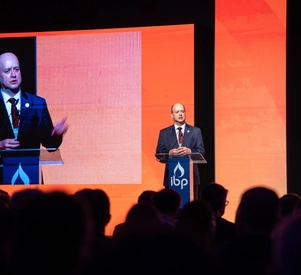
Brazil’s growing prominence becomes even more relevant in light of recent tensions in Venezuela. With uncertainty surrounding supply flows in the Caribbean region, global markets are increasingly looking to reliable and stable producers. According to Roberto Ardenghy, President of IBP, Brazil, as the world’s eighth-largest oil producer, plays a critical role in global energy security.
“Brazil’s oil and gas industry is a driver of economic growth and strategic positioning. In a world marked by geopolitical volatility, our sustainable production—particularly from the pre-salt fields, which emit half the carbon intensity of the global average—provides the reliability that global markets demand,” said Ardenghy.
Growth Projections (2025–2029)
IBP projects that the current expansion cycle is only beginning:
- Production Peak: Output is expected to reach 4.2 million barrels per day in 2028.
- Investments: Upstream investments are projected to peak at US$21.3 billion as early as 2026.
- Employment: The sector is expected to support 483,000 jobs next year.
- Government Revenues: Total government revenues generated by the sector could reach US$42.3 billion annually by 2029.
Leadership in the Energy Transition
Beyond its fiscal and foreign exchange contributions, IBP highlights the sector’s leading role in Brazil’s decarbonization efforts. Brazil is the world’s second-largest producer of biofuels and continues to advance cutting-edge technologies such as Carbon Capture, Utilization and Storage (CCUS), while also holding an estimated 1,200 GW offshore wind potential.
“Brazil’s energy transition is gaining momentum and is being enabled by the competitiveness and resources generated by the oil and gas industry itself,” Ardenghy concluded.